No One Left to Wait For It
I remember the first day the sun no longer rose. The world ended not with a bang, but with a whisper of ash on the windowpanes. We were intellectuals, analyzing the end of the world as a theoretical problem, until the grey dust became our reality, forcing us to confront the stark choices of survival.
I remember the first day the sun no longer rose. The world ended not with a bang, but with a whisper. A whisper of ash on the windowpanes. At first, we thought it was rain. Initially, we watched the news with the morbid fascination of those who felt safe. The caldera of Naples, the Phlegraean Fields, that sleeping monster beneath one of the world's oldest cities, had awakened. Southern Italy had been wiped off the map in a matter of hours. A tragedy, of course. But a distant tragedy, a spectacle on a screen, between dinner and the evening film.
I was an engineer. I spent my evenings modeling particle dispersion, and on Sundays, I read comic books to Sofia until she fell asleep, tracking jet streams with the curiosity of a man who still believed that understanding was enough. An illusion of control, a bulwark of numbers against anxiety. Elena, my wife, a doctor, worried about acid rain, about the impact on crops. She felt things with her heart, not with equations. “We should leave,” she told me one evening, when the ash had barely begun to fall. “Not for us. For her.” I didn’t listen. I was still caught in my calculations, in my certainties. We were intellectuals, comfortably settled in our house in northern France, analyzing the end of the world as a theoretical problem.
Our daughter, Sofia, eight years old, drew volcanoes whose black smoke devoured the sky and houses. She never drew people. Never. As if, from her eight years, she had already understood that we were no longer the main subject.
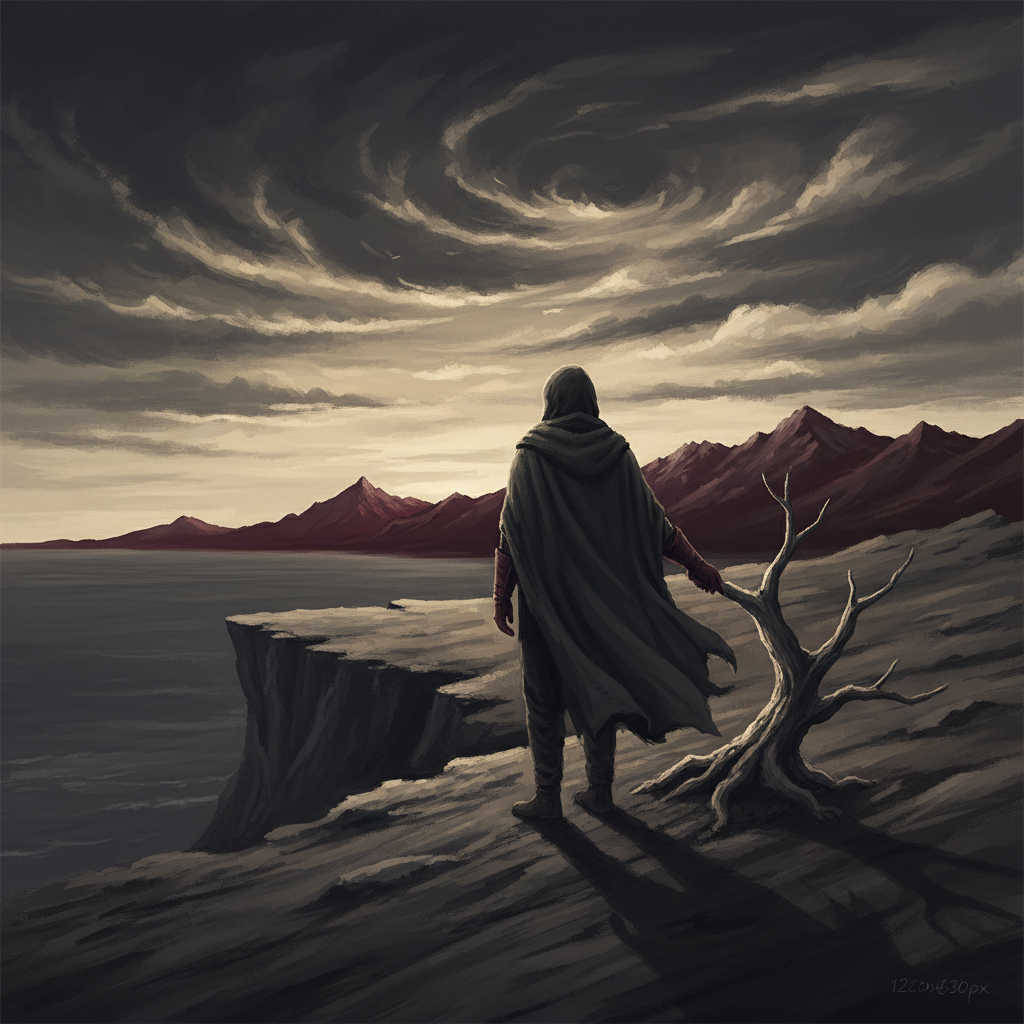
And then, the whisper reached us. A fine grey dust, almost impalpable, settled on cars, roofs, tree leaves. It had an odor: stone and sulfur, the breath of the Earth’s core. The sky took on a permanent sepia tint. The sun became a milky, impotent disk that no longer warmed anything. The birds fell silent first, before the humans. That’s when I understood. This was not a theoretical problem.
Our last night in the house, we barely slept. The ash seeped through the window cracks, forming a grey film on the table, on the frames, on forgotten toys. Every object already seemed to belong to a bygone era. Elena tidied without apparent reason, closing drawers, smoothing sheets. At one point, she placed her hand on my shoulder. She didn’t remove it immediately. I watched her, unable to ask what she hoped to preserve.
Sofia, meanwhile, sat on the floor, legs crossed, watching the dust float in the lamp’s beam. She didn’t speak. She didn’t cry. She watched as one watches something one tries to understand without judgment. I wondered if it was us she was truly observing. And for the first time, I was afraid of her.
Panic was faster than the ash. Electrical grids failed one after another. Communications became a luxury, then a memory. The house, our refuge, became a cage of silence. Outside, the wind slid the ash across the asphalt, like a patient snake. We had to leave. Flee. But to go where? Instinct said north, away from the cloud. My models said prevailing winds condemned the entire continent. Leaving was just a reflex. An absurd act of faith. We left anyway.
The highway was a graveyard of metal. Haggard families wandered the asphalt, their eyes empty, pushing shopping carts filled with useless things: a television, an empty birdcage, photo frames. Some wore surgical masks, grey with ash. Others walked with open faces, as if it no longer mattered.
At a rest stop, I opened the car door. The air hit me like a warm dust slap. A man approached our car. He held a child in his arms, a child coughing dry dust. He asked for petrol. I shook my head no. He insisted, his voice breaking: “Please. Just a few liters. For him.” Another emerged from the shadows, a wrench in his hand. I understood. I started the engine. The first man fell to the side. In the rearview mirror, I saw his face. No anger. Just despair.
Elena said nothing. She took Sofia’s hand. The silence in the car became heavier than the ash outside. The air entering through the vents tasted of stone. Our throats were dry, irritated. We drove for two more hours without speaking. Sofia eventually fell asleep against the window, her cheek resting on the cold glass. Elena watched the road. I watched Elena.
We found refuge in an isolated farm, with about ten other survivors. An elderly couple who had supplies. A schoolteacher who no longer spoke. A single woman with a crying infant at night, whom everyone watched with a dull hostility. Every can of food was counted. Every glance, weighed. The smell of damp straw mingled with the sharper scent of fear. At night, our dry, hoarse coughs echoed from one end of the dormitory to the other. We slept with our belongings under our heads.
One night, they arrived. Hungry shadows, armed with sticks and knives. Fear has an odor: sweat and metal. In the confusion, a man grabbed Sofia by the arm. She didn’t scream. She looked at him with that calm that always chilled me. I grabbed the iron bar I kept under my bed. The sound of bone breaking is a dull, definitive sound. The man collapsed. I watched him die. I felt nothing. Not even relief.
Elena dressed the cut on my arm, her fingers precise and distant. She treated my wounds as she treated strangers: with competence, without looking at me. The next morning, the infant no longer cried. Its mother sat in a corner, holding it close, her eyes fixed on a point no one else saw. No one asked her questions. No one called Elena. We already knew.
We left the farm at dawn, without looking back. The following weeks were a long march through a decomposing world. We crossed cities where the silence was only broken by the wind in empty streets, forests where dead trees stretched their branches like skeletons. We learned to read the signs: an open door, an abandoned car, an empty can. Each day was a precarious victory. Europe was a corpse. The sun was just a story we told Sofia in the evenings, so she wouldn’t forget the blue. A rumor guided us: a governmental bunker to the north. An ark. The last hope.
The road north no longer resembled a road. The air seemed thicker, heavier, as if each breath required a decision. In a village where doors rattled in the wind, we found an abandoned house. Inside, a table still set: two plates, two glasses, a candle burned down to its wick. Someone had waited for someone who never came. Sofia picked up a small silver spoon from the table. She slipped it into her pocket without a word. She looked up at me. “Will we come back?” I said yes. I told her nothing.
We found the concrete and steel structure. In front, a crowd. Thousands of individuals pressed against fences, begging, crying, fighting. Soldiers in protective gear stood guard. Selection was underway. Voices shouted out professions like prayers. Some brandished laminated diplomas, others children. A man in a white coat shouted his name and profession. The guards let him and his wife through. Their two teenage children were pushed back. The woman turned once. She looked at her children from the other side of the fence. Then she stopped looking at them.
Elena pulled out her professional card. “Doctor.” The gate opened for the three of us.
I looked at the crowd from the threshold. Those hands reaching through the bars. I watched the soldiers push people back with rifle butts. A mechanical movement. Efficient. Inside, white coats bustled. The necessary ones. I looked at the woman who hadn’t turned back. She walked straight ahead. She had chosen function over blood.
I looked at Sofia. She watched this woman without judgment, without emotion. She observed, as she had observed the man dying under my iron bar.
Elena squeezed my arm. A pressure to urge me forward. I took her hand. I took their hands. In hers, I felt the small silver spoon, cold. And without a word, I turned back.
We walk. The ash crunches under our feet with every step. Our hair is grey, our skin dry. Tonight, we sleep in an abandoned barn, under blankets that smell of dust and animal. Elena falls asleep before me. I stay awake in the dark. I think of Sundays.
Sofia doesn’t sleep. She stares at the ceiling with the same attention she watched the man fall. I think back to her drawings. To the faceless volcanoes. To the windowless houses. In her pocket, the small silver spoon.
I wonder if she ever drew it. Perhaps the sun didn't rise. Perhaps there was no one left to wait for it.
The ash still falls.
Author — philosophievivante.com
Be the first to comment
No comments yet.
Be the first to share your thoughts.
The philosophical letter
A weekly reflection on the ideas shaping our era.