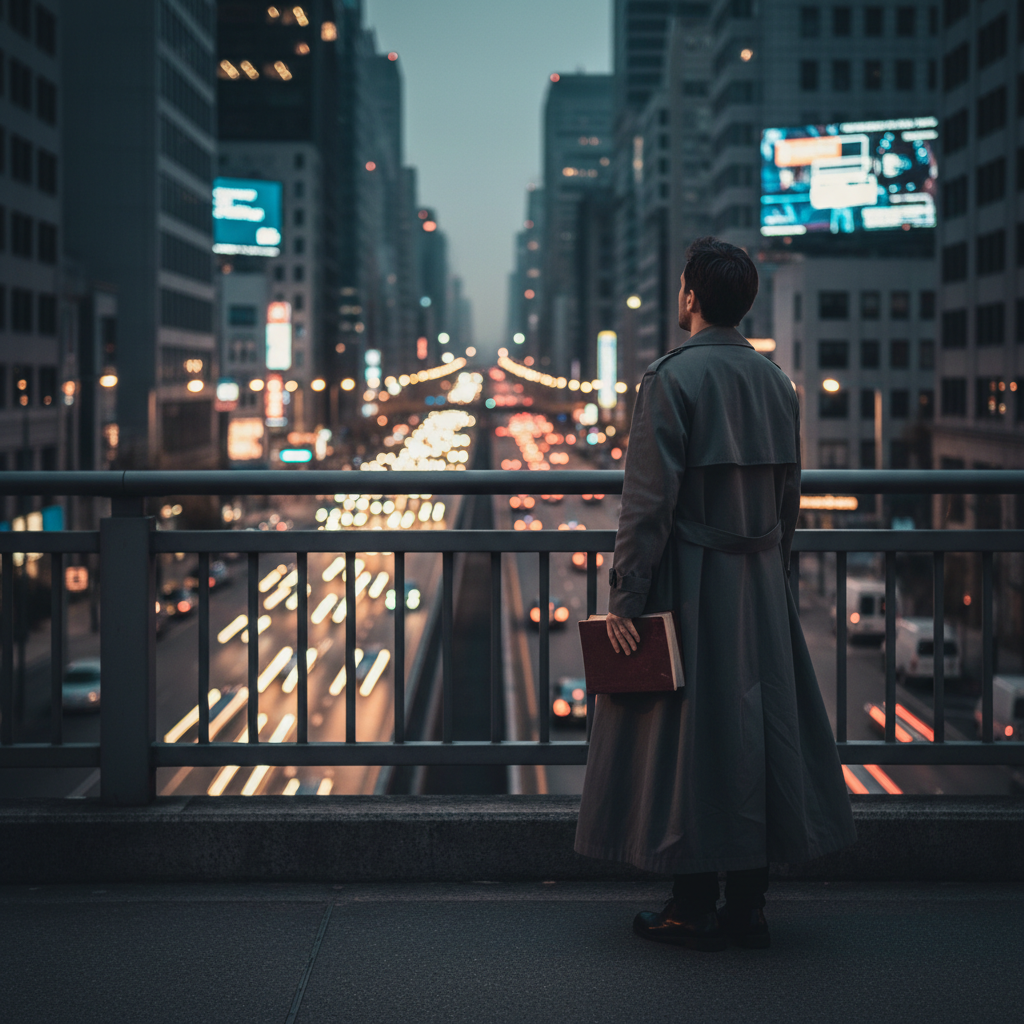
A screen lights up, a notification flashes, a news feed scrolls at dizzying speed. We are in 2024, and time, that commodity once measured by natural cycles and social rhythms, has transformed into an uninterrupted succession of solicitations. Every moment is an injunction to efficiency, reactivity, consumption. In this incessant whirlwind, where does literature still find its place? Has this slow process of reading, this solitary immersion in worlds of words, not become an obsolete luxury, a relic of a bygone era? This question, far from trivial, interrogates the very nature of our humanity and the profound needs that modern frenzy tends to obscure.
Long Time Versus Short Time: A Necessary Resistance
The primary function of literature, in a hurried society, is to offer resistance to the cult of immediacy. To read a novel, an essay, a poem, is to engage in a long time, a time that is not one of instant information, but one of maturation, of sedimentation. It is to agree to suspend the incessant flow of stimuli to dedicate oneself to a work that demands patience and concentration. This discipline of attention is, in itself, a subversive act. It tears us away from the tyranny of the perpetual present, where every event is immediately replaced by the next, leaving no room for reflection. Literature invites us to slow down, to settle, to let words resonate within us, to weave connections between ideas, emotions, experiences. It is a school of duration, a training in intellectual and emotional perseverance. By offering us this interlude, it allows us to regain a form of sovereignty over our own time, to no longer be merely passive recipients of a flow of information, but conscious actors of our own inner journey. It is a return to the sources of thought, a reaffirmation of the value of contemplation in a world that swears only by action.
Mirror and Window: Understanding Humanity and the World
Beyond this temporal resistance, literature remains an unparalleled tool for understanding humanity and the world. It acts as a mirror, reflecting our own image, our own doubts, our own joys and sorrows. Through characters, situations, dilemmas, we explore the depths of the human psyche. Depth psychology finds in literature an unrivaled field of expression and exploration. Great novelists, from Dostoevsky to Virginia Woolf, from Balzac to Toni Morrison, have depicted with striking acuity the intricate paths of the soul, hidden motivations, internal conflicts, social dynamics, and power structures that shape our lives. They offer us a cartography of emotions, passions, collective and individual neuroses. By identifying with characters, by confronting their choices, we develop our empathy, that capacity to put ourselves in another's shoes, so essential in a fragmented society. But literature is also a window. It opens us to other cultures, other eras, other ways of thinking. It deconstructs our prejudices, broadens our horizons, confronts us with the diversity of reality. It is a powerful antidote to ethnocentrism and solipsism, reminding us that our experience is but one among many, and that the complexity of the world far exceeds our immediate perceptions. Cultural anthropology feeds on it, finding foundational narratives, myths, rituals that illuminate the invariants and variations of human experience. It allows us to grasp the invisible threads that connect individuals to societies, personal destinies to grand historical frescoes.
Meaning and Silence: An Existential Quest
In a society dominated by noise and information, literature offers a space of silence and meaning. It invites us to ponder the great existential questions: the meaning of life, death, love, freedom, justice. These questions, often relegated to the background by the urgency of daily life, are at the heart of any literary work worthy of the name. Philosophy, in all its forms – ontology, ethics, epistemology – finds in literature a concrete embodiment of its abstract interrogations. A novel is not a philosophical treatise, but it stages lives that embody ethical choices, worldviews, quests for truth. It confronts us with the contingency of existence, the fragility of our certainties. Literature helps us to name the unspeakable, to express what resists the words of everyday language. It explores the shadow zones, the paradoxes, the ambiguities of human experience. It allows us to give form to our anxieties, our deepest desires, our highest aspirations. In a world that tends to homogenize experiences and simplify narratives, literature is a sanctuary of complexity, nuance, individuality. It reminds us that meaning is not given, but constructed, interpreted, constantly questioned. It pushes us to look beyond appearances, to dig beneath the surface of things, not to settle for ready-made answers. It is, in this sense, a school of freedom of thought, an invitation to forge our own vision of the world, enriched by the confrontation with the thousand and one perspectives it offers us.
The Imaginary as the Engine of Reality: The Power of Narrative
Finally, literature nourishes the imagination, that essential faculty that allows us to conceive of other possibilities. In a society that tends to confine us to reality as it is, the imaginary is a force of transformation. It is the breeding ground for innovation, creativity, the ability to dream of a better world. Narratives, whether mythological, novelistic, or poetic, are the matrices of our civilizations. They structure our thoughts, our values, our actions. The sociology of imaginaries shows us how collective narratives shape the identities and destinies of human groups. Literature is a space where one can experiment, without risk, with other lives, other worlds, other value systems. It offers us models, counter-models, utopias, dystopias. It allows us to project ourselves, to anticipate, to criticize, to build. It is a laboratory of the human, where ideas can be tested, consequences explored, emotions experienced vicariously. By nurturing our capacity to imagine, it strengthens our power to act on reality. For it is first in the mind that changes, revolutions, evolutions are born. A world without literature would be an impoverished world, a world without dreams, without horizons, condemned to endlessly repeat the same patterns. Literature, by cultivating our imagination, gives us the tools to think about the future, to desire it and to build it. It is the breath that animates our capacity to reinvent ourselves, individually and collectively.
In this hurried world, where urgency seems to dictate every step, literature is therefore not mere entertainment or an outdated luxury. It is a vital necessity. It is the place where we rediscover the time to think, the meaning of humanity, the depth of existence, and the power of the imaginary. It invites us to a fruitful pause, to an intimate dialogue with ourselves and with others, across eras and borders. It is an act of resistance, a path towards a sharper awareness of our condition. So, perhaps, the question is not so much what purpose it serves, but rather how we could do without it without irrevocably impoverishing ourselves.
---
Sylvain Delahaye